On July 19, Great Wall Motor (GWM) unveiled two models in a single day: the all-new Tank 300, a hardcore off-roader, and today’s protagonist — the GWM H10, a “pan-off-road” SUV.
The GWM H10 is the first “boxy” model built on GWM’s Guiyuan S platform. It features an embedded ladder frame, making it a city SUV with genuine off-road character. Sharing the same platform as the Wey V9X, it is **not** a hardcore off-roader抖音百科.
So, can the GWM H10 serve as an affordable alternative to the Wey V9X? And can it challenge the BYD Fang Cheng Bao Ti7, the dominant player in the pan-off-road segment?
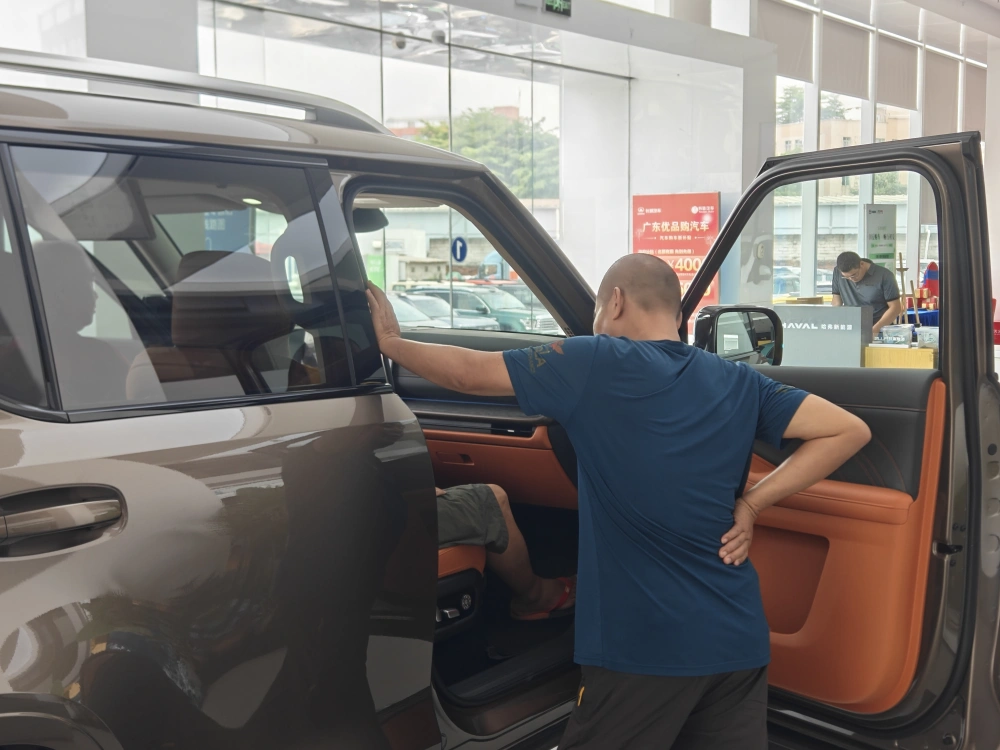
To find out, we visited a GWM dealership to experience the H10 first-hand and talk with other customers — and we finally figured out exactly who this car is for.
### Mature Buyers Line Up; GWM Remains Their Favorite
The GWM H10 is offered in 5-seat and 6-seat configurations, with the 6-seat version stretching 161 mm longer. At the dealership we visited, only the 6-seater was on display.
Standing in front of the H10, it immediately became clear why more and more buyers are choosing pan-off-road vehicles. Its rugged, boxy design and 5,299 mm length deliver a commanding presence far beyond that of traditional SUVs. Add the automatically deploying running boards when the doors open, and if the badges were covered, you’d easily mistake it for a vehicle costing 400,000–500,000 yuan.
The H10 adopts a column-mounted shifter, head-up display (HUD), and retains a physical instrument cluster. The cabin is wrapped in soft-touch materials, and the front two seats (on high-trim models) offer massage functions — a rare feature in this segment.
Like other 6-seat SUVs, with the front two seats adjusted for comfort, the third row feels tight, and the trunk space is nearly non-existent. Fortunately, the third-row seats fold flat, letting you choose between a large cargo area or six seats.
It runs on GWM’s Coffee OS 3, which boasts smooth animations and a highly intelligent voice assistant. During our test, a single voice command with three operations and a follow-up dialogue was executed accurately. Rear passengers also get a 17.3-inch entertainment screen for movies and games.
Overall, among all large SUVs we’ve tested, the GWM H10 ranks near the top. If there’s a shortcoming, it’s the absence of a 2.0T engine like the all-new Tank 300. Given the Tank 300’s hardcore off-road positioning requiring more power for extreme conditions, this difference is understandable.
Even on a Monday morning — when most people are at work — the dealership was packed, mostly with men aged 40–50. Some arrived in groups, seemingly old friends; one father brought his 6–7 year-old son.
In the ICE era, when Chinese brands were overshadowed by joint ventures, GWM stood out. The Haval H6 led SUV sales for nine consecutive years, built on reputation and reliability.
Reliability and practicality have always defined GWM. Back when China’s economy was less developed, GWM’s sales came from high-quality, affordable models. Today, with greater purchasing power, loyal owners are willing to upgrade to the pricier GWM H10.
One customer, Mr. Wang, told us he’d used a Haval H6 for years to carry workers and materials, trusting GWM’s quality. Now considering a new car, he brought friends to see the H10 — its boxy design perfectly matches their taste.
### In the Pan-Off-Road Era, GWM Takes on the Ti7
New energy and smart tech have addressed hardcore off-roaders’ high fuel consumption, poor comfort, and high entry barriers, turning the once niche segment mainstream.
Data from the China Association of Automobile Manufacturers shows the domestic off-road market reached 223.5 billion yuan in 2025, growing over 100% in five years. GWM remains a leader, with the Tank 300 topping off-road sales for six straight years.
Yet consumers rarely go off-roading in deserts or Gobi. Most want a pan-off-road vehicle with rugged styling, high-power external discharge, for weekend camping and fishing.
It’s not just GWM; BYD, Chery, and AITO (with BAIC) will launch the AITO G9 pan-off-roader later this year.
Pan-off-road sits between city SUVs and hardcore off-roaders: no body-on-frame construction, light off-road capability, lower fuel consumption, and higher comfort.
The BYD Fang Cheng Bao Ti7 is currently the top-selling pan-off-roader, with over 200,000 deliveries by July 20 — earning the title of “fastest boxy SUV to hit 200,000 sales.”
Compared to the Ti7, the GWM H10 is 300 mm longer (139 mm in wheelbase), offers a 6-seat option, comes standard with LiDAR, and has second-row massage on high trims. It matches or beats the Ti7 in every aspect.
The all-new Tank 300 stays focused on hardcore off-roading with body-on-frame, Hi4-Z/T four-wheel drive, and professional gear, leading the segment for extreme adventures.
As the first boxy model on the Guiyuan S platform, the H10 targets “urban commuting + family travel + light off-roading” for mainstream families. Its embedded ladder frame balances comfort and light off-road ability, while the long-wheelbase 6-seat layout and standard LiDAR set it apart from the Ti7 — ideal for large families and long camping trips, and the perfect alternative to the Wey V9X.
The two models complement each other: Tank 300 for hardcore, H10 for family pan-off-roading, forming a full product matrix. As competition intensifies, the Ti7 has an early lead, but GWM leverages its decades-long SUV reputation.
### The GWM Brand: H10’s Biggest Advantage
Notice the name: not “Haval H10,” but “GWM H10.” This reflects the ONE GWM global strategy, unifying Haval, ORA, and GWM Cannon under the GWM brand.
At the dealership, the H10 has no “Haval” badge on the rear — only the “HAVAL” logo on the front grille, wheel center caps, and the voice wake-up “Hi, Haval.”
GWM’s strategy positions the main brand to cover entry to premium segments, with Wey for luxury and Tank for off-roading.
The H10’s real strength isn’t just hardware like 6 seats or LiDAR, but the brand equity from ONE GWM — the reason it can challenge the Ti7. Dropping the Haval name isn’t just rebranding; it’s a key step for GWM’s upward and global expansion.
Previously, separate brands led to fragmented marketing and channel conflicts. Unifying under GWM lets the H10 benefit from decades of trust, appealing to practical, reliability-focused middle-aged buyers — a unique edge over new entrants and BYD.
The unified system also integrates R&D, supply chains, and after-sales, cutting costs and improving convenience for owners.
Internally, the H10 and Tank 300 form a pan-off-road + hardcore off-road matrix, filling the 200,000-yuan gap. Externally, it supports both domestic premium growth and global expansion. Shedding the Haval label, the H10 moves beyond affordable family transport to carry GWM’s mainstream upward push — brand power beats hardware alone.