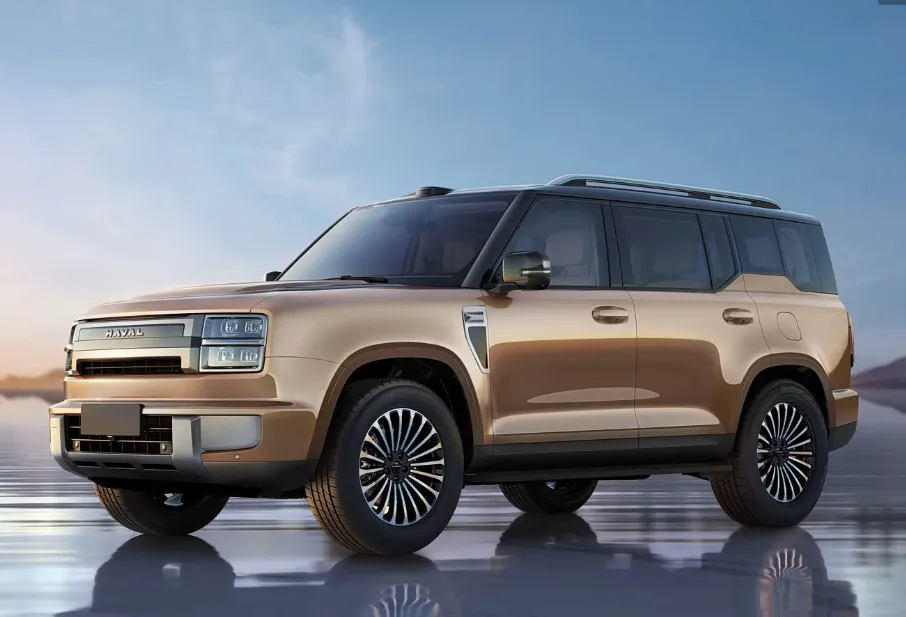
The automotive market has been bustling lately. Car shoppers with a budget of around 200,000 RMB looking for a rugged SUV now face a tough choice between two competitive models: the newly launched GWM H10 and the BYD Fangchengbao Ti7, which has been on sale for nearly a year.
GWM H10 officially opened for pre-orders on July 18. It offers four variants with a pre-sale price ranging from 219,800 RMB to 239,800 RMB. A limited-time promotional price cuts the range to 214,800 RMB - 234,800 RMB. As for the Fangchengbao Ti7, it debuted in September last year with an official price of 179,800 RMB to 219,800 RMB. An EV fast-charging version was added at the end of April this year. The two vehicles overlap greatly in pricing and positioning as new energy boxy SUVs, creating direct competition. Let’s take an in-depth look to see which one is more worthy of your purchase.
Exterior Design
GWM H10 adopts the "Square Ding Aesthetics" design inspired by ancient Chinese bronze square tripods. It features straight lines and sharp angles with few curved surfaces, presenting a classic boxy silhouette. The front is fitted with matrix square headlights, a narrow grille and thick dual chrome trims, delivering a powerful rugged vibe.
The Fangchengbao Ti7 follows the "Stellar Ark" design language, showcasing a more avant-garde and futuristic style. Its closed narrow grille is paired with full-width daytime running lights and split dual-layer headlamps. The robust front bumper with dual-color panels and silver skid plates also highlights its off-road capability.
Body Dimensions & Off-road Parameters
The 5-seater GWM H10 measures 5138×2050×1970 mm, while the 6-seater version stretches to 5299 mm in length. Both variants share a wheelbase of 3000 mm. Its nearly 1:1 width-to-height ratio, short front overhang, long wheelbase and high body create a steady stance like a bronze tripod. The blade-shaped taillights draw inspiration from tripod carvings, and a blue eye-like light will illuminate at the center when the intelligent driving system is activated.
The Fangchengbao Ti7 has dimensions of 4999×1995×1865 mm and a wheelbase of 2920 mm. It is 300 mm shorter in length and 80 mm shorter in wheelbase than the H10, resulting in a noticeable gap in interior space. Both models achieve an approach angle of 24° and a departure angle of 25°.
Interior & Intelligent Configuration
The two cabins adopt totally different layouts. GWM H10 is equipped with an enveloping cockpit, including a 10.25-inch full LCD instrument cluster, a 15.6-inch central control screen and a 29-inch SR-HUD. Higher trims add a 17.3-inch rear entertainment screen. Powered by Coffee OS and Qualcomm Snapdragon 8295 chip, it supports four-zone wake-free voice control. The entire lineup comes standard with lidar and Coffee Pilot 3 intelligent driving system. Equipped with 27 sensors, it realizes full-scene NOA with a forward detection range of 250 meters.
The Fangchengbao Ti7 features a dual-layer floating center console and a four-spoke steering wheel. Its cabin supports linkage of seven screens: a 15.6-inch central display, a 12.3-inch instrument panel, a 26-inch W-HUD, an air conditioner control screen, a rear air conditioner panel, and two optional 13-inch rear entertainment screens. It adopts the Tianzhi Eye B driving assistance system with lidar, 30 perception hardware and over 30 driving assistance functions.
Riding Space & Practicality
Space is the biggest distinction between the two models. The 6-seater GWM H10 has an effective cabin length of 3270 mm and a 192 mm wide middle aisle in the second row, allowing easy access to the third row for the elderly and children. The 358 mm height of the third-row seats eliminates the cramped feeling. Its seats adopt an 11-layer composite structure. The driver’s seat supports 12-way electric adjustment, ventilation, heating, 10-point massage and headrest speakers. The second row of the 6-seater version is equipped with 60° leg rests and 180 mm long sliding rails. There are 42 storage spaces throughout the car, and the trunk can hold five 20-inch suitcases even with all three rows of seats in use.
The Fangchengbao Ti7 uses premium leather seats with a four-layer "Soufflé" structure. Front seats are standard with heating, ventilation and massage functions. Its effective cabin length reaches 3310 mm with a space utilization rate of 70.9%, and the headroom for front and rear passengers is nearly 1.1 meters. The regular trunk volume is 970 L, expanding to 1000 L with an extra storage compartment, and up to 1880 L after folding the second-row seats. However, the Ti7 is only available as a 5-seater, which is a clear drawback for families with two kids.
Powertrain & Chassis
GWM H10 is fitted with the Hi4 plug-in hybrid system consisting of a 1.5T engine and dual motors. The engine delivers 123 kW, while the front motor outputs 100 kW and the rear motor 220 kW. The combined system power hits 440 kW. Matched with a 42.8 kWh battery pack, it achieves a CLTC pure electric range of 232 km or 227 km, and a maximum comprehensive range of 1404 km. It can add 126 km of range within 15 minutes of fast charging. The chassis adopts double wishbone front suspension and five-link rear suspension, paired with EDC adaptive dampers, iTVC intelligent torque vectoring system and rear electronically controlled mechanical differential lock.
The Fangchengbao Ti7 carries BYD’s DM plug-in hybrid system with 2WD and 4WD options. Its 1.5T engine generates 115 kW. The total system power stands at 200 kW for the 2WD version and 360 kW for the 4WD version. It offers two battery options of 26.6 kWh and 35.6 kWh, delivering a CLTC pure electric range of 135 km, 190 km or 200 km. It also launches an all-electric fast-charging variant with a maximum pure electric range of 755 km. Equipped with double wishbone front and five-link rear suspension as well, it features BYD DiSus-C intelligent damping system and anti-motion sickness mode.
Conclusion
Both models have their unique strengths for different groups of buyers. If you have two children and often travel with elderly family members, the 6-seater GWM H10 is the top choice. Its 3000 mm wheelbase and 5299 mm body length provide unmatched spaciousness. Starting at 214,800 RMB under the limited offer, it boasts outstanding cost performance for a large 6-seater PHEV SUV. It received over 22,000 orders within 12 hours after pre-sales opened, proving its market popularity.
If you only need a 5-seater vehicle and have a tighter budget, the Fangchengbao Ti7 starting at 179,800 RMB is a better pick, 35,000 RMB cheaper than the H10. The extra budget brings a more agile body, DiSus-C chassis, reliable intelligent driving functions and proven market performance.
In short, GWM H10 wins in interior space and driving range, while Fangchengbao Ti7 takes the lead in cost performance and flexibility. Choose GWM H10 without hesitation for big families needing six seats; go for Ti7 if a practical 5-seater is enough. Both are excellent vehicles designed for diverse demands.