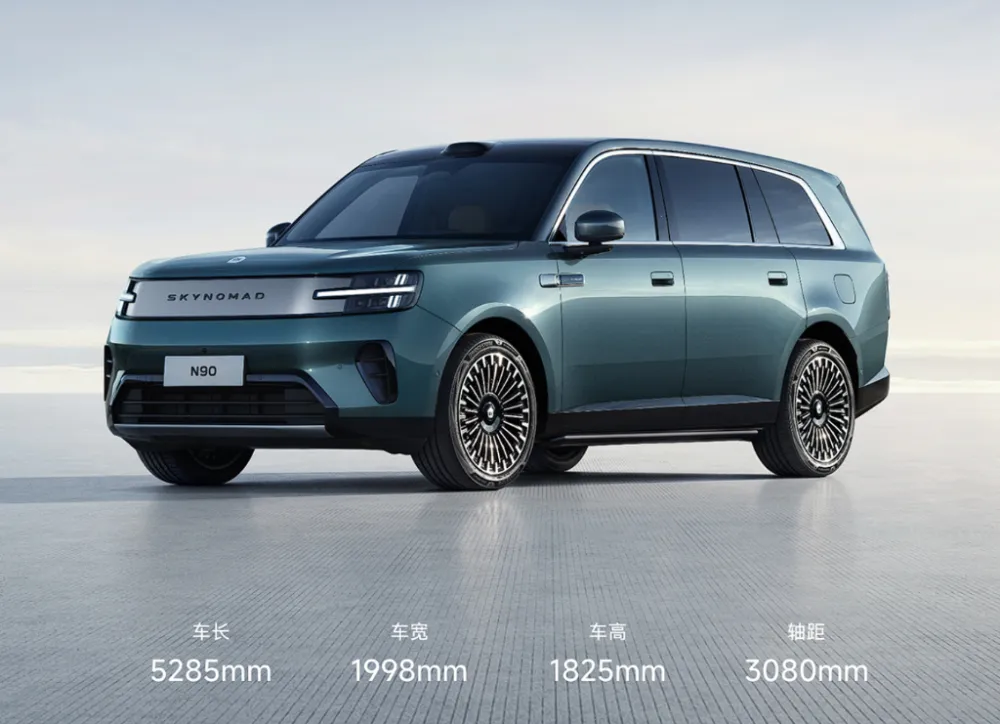
At its 2nd Automotive Technology Day hosted in Beijing on July 30, 2026, Xiaomi officially unveiled its all-new Kunlun Technology Architecture and the SkyNomad extended-range electric vehicle (EREV) SUV lineup. The launch marks its strategic shift from sporty battery electric vehicles (BEVs) to the large-space family extended-range EV segment. Pre-orders opened for the flagship seven-seat N90 Max and large five-seat N70 Max at RMB 299,900 and RMB 259,900 respectively.
According to Trading Wind Platform, Wall Street investment banks including Morgan Stanley, Deutsche Bank, Nomura and Citi have quickly reached a consensus: Xiaomi is rolling out an extremely aggressive volume-driven pricing strategy to hit its ambitious annual sales target of 550,000 vehicles in 2026. Morgan Stanley and Deutsche Bank view the new lineup as a powerful sales catalyst. By contrast, Citi and Nomura have issued clear warnings to investors. Loaded with extensive hardware configurations, the new models create massive uncertainty over Xiaomi’s gross margin prospects. Furthermore, the N70 series risks internal cannibalization by competing head-on with its in-house YU7 model.
Analysts note that the core debate has shifted from “Can Xiaomi build competitive cars?” to “Can Xiaomi absorb massive production capacity and order intake while safeguarding its gross profit margins?”
Aggressive Pricing Resets Industry Benchmarks, Targeting 550,000 Annual Deliveries
Xiaomi’s pricing strategy has completely defied Wall Street’s forecast models.
Nomura stated the market previously anticipated the N90 series to be priced between RMB 300,000–350,000, and the N70 series from RMB 250,000–300,000. The actual pre-sale prices of RMB 299,900 for the N90 Max and RMB 259,900 for the N70 Max sit at the lower bound, or even below market expectations, demonstrating clear intentions to drive sales volume via pricing.
Morgan Stanley further predicts that following the official launch in September, upcoming Standard and Pro variants will lower entry thresholds further. The N70 series is expected to cover the RMB 200,000–250,000 bracket, while the N90 series will span RMB 250,000–300,000.
Competitive pricing analysis from Citi shows the N90 Max is roughly aligned with the ONVO L90 Pro (starting at RMB 265,800), yet significantly undercuts Li Auto L9 (starting at RMB 509,800), AITO M9 (starting at RMB 479,800) and Zeekr 9X (above RMB 450,000). The model has the potential to reset the price-spec benchmark for large family SUVs.
Deutsche Bank believes the SkyNomad lineup will compete directly against mid-tier SUVs from BYD, Leapmotor, Xpeng, Geely, Lynk & Co, Chery and Volkswagen, while posing latent competitive pressure on premium brands including Li Auto, Tesla, Zeekr and AITO.
The bank pinpoints the logic behind this aggressive pricing: Xiaomi’s urgent pursuit of higher sales volumes. Data shows Xiaomi delivered only 180,055 vehicles in the first half of 2026, accounting for merely 34% of its full-year 550,000-unit target.
To meet the target, Xiaomi needs to sell an average of 61,000 vehicles per month in the second half of the year. Per Thinkercar statistics, Xiaomi’s new order intake remained sluggish throughout July, registering 5,400, 5,600, 7,400 and 5,700 units across four consecutive weeks. The launch of SkyNomad is seen as a critical catalyst to lift order volumes.
Maxed-Out Hardware: Large Battery Packs and the Kunlun Architecture’s Cost Profile
On product strength, Xiaomi aims to redefine space and configuration standards for family SUVs through the Kunlun Architecture.
Research reports from Citi and Deutsche Bank break down the high-spec hardware package in detail:
N90 Max (7-seater): 5,285 mm in length, 3,080 mm wheelbase. Equipped with a 76 kWh large-capacity ternary lithium battery, delivering a CLTC pure-electric range of 464 km and a combined range of 1,705 km. It features a 310 kW dual-motor all-wheel-drive system with a 0–100 km/h acceleration time of 5.9 seconds. The cabin offers a 2.9-meter flat floor and 4.4 sqm usable interior space; the trunk can expand to a maximum volume of 1,831 liters.
N70 Max (5-seater): 4,960 mm in length, 2,950 mm wheelbase. It carries the same 76 kWh battery pack, delivering a class-leading CLTC pure-electric range of 505 km and combined range of 1,461 km, with 0–100 km/h acceleration in 5.5 seconds.
Notably, both Max trims come standard with air suspension, CDC (Continuous Damping Control) dampers, LiDAR, and the NVIDIA DRIVE AGX Thor smart driving chip with 700 TOPS of computing power.
Deutsche Bank spotted key cost-control maneuvers by Xiaomi. To support the aggressive pricing, Xiaomi has adopted more cost-competitive battery suppliers – Sunwoda and CALB – for the SkyNomad series, instead of CATL and BYD, which supply its pure electric vehicle lineup.
Wall Street Concerns: Margin Risks and Internal Product Cannibalization
Despite compelling product specifications, Wall Street analysts remain cautious and have outlined clear risk factors for investors.
First, uncertainties surrounding gross profit margins.
Citi’s report highlights a core contradiction in the investment case for the SkyNomad range. The large 76 kWh battery, dual motors, range extender, air suspension, LiDAR and complex multi-mode seating systems translate to high bill-of-materials (BOM) costs, while the aggressive pricing framework creates direct pressure on gross margins.
Citi identifies four key metrics investors should closely monitor:
Final official pricing (whether further adjustments will be made at the September launch)
Order conversion rate (proportion of reservations converted into finalized vehicle purchases)
Production ramp-up speed (capacity to scale output rapidly)
Model-level gross margin (ability to sustain reasonable profitability under low-price strategy)
Second, tangible challenges to hitting sales targets and risks of internal product cannibalization.
Nomura Securities ran the numbers: assuming steady sales of the existing SU7 and YU7 models (historical average monthly sales of 10,500 and 25,000 units respectively), the SkyNomad series needs to deliver roughly 156,500 units between September and December – equivalent to around 39,100 units monthly – for Xiaomi to achieve its annual target. Such a steep production ramp-up appears highly ambitious.
More critically, the N70 Max overlaps heavily with Xiaomi’s pure electric SUV YU7 in dimensions (4,960 mm / 2,950 mm wheelbase versus 4,999 mm / 3,000 mm wheelbase) and five-seat layout, with directly competing price brackets (YU7 Standard: RMB 233,500; YU7 Pro: RMB 279,900).
Industry forecasts indicate the N70 series will inevitably eat into a portion of potential YU7 buyers.
Jade holds a relatively optimistic view. He believes the SkyNomad lineup, supported by innovative design and attractive pricing, is poised to achieve robust sales performance and could serve as a positive catalyst for Xiaomi’s stock price.