Wang Ye’s Finance News: Three Chinese Automakers Break Into the World’s Top‑10 Best‑Selling Car Groups — Is This for Real?
Can you believe it? Three Chinese car brands have stormed into the global top‑10 sales rankings.
This is no token appearance at 8th or 9th place. BYD, Geely and Chery have all secured their seats at the global table.
For decades, this ranking has been dominated by Toyota, Volkswagen, Hyundai and other established players. Chinese automakers were barely even in the picture.
Today, however, China is not merely represented — it has arrived as a group.
Is this down to luck, or genuine strength? What sets these three companies apart? What major underlying messages does this milestone carry?
01 Three Chinese Carmakers in the Global Top 10
The figures are compiled by Cui Dongshu, Secretary‑General of the China Passenger Car Association (CPCA), based on data from the International Organization of Motor Vehicle Manufacturers, making them highly credible.
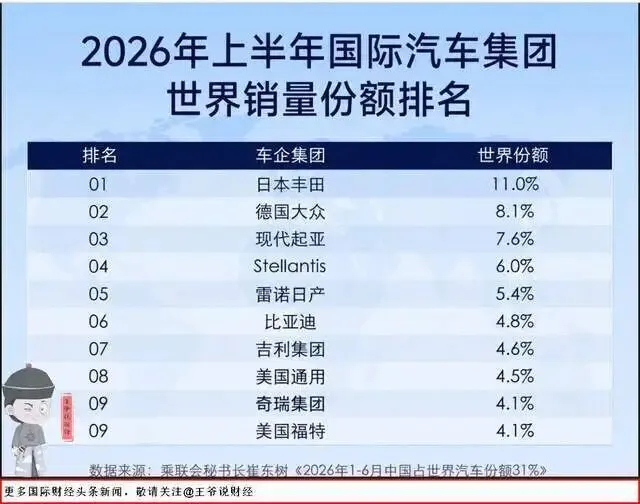
In H1 2026, global automaker market share rankings stood as follows: Toyota retained first place with 11%; Volkswagen ranked second at 8.1%; Hyundai‑Kia took third.
Further down the list: BYD came 6th (4.8%), Geely 7th (4.6%), and Chery tied with Ford for 9th (4.1%).
In short: three Chinese brands sit within the global top 10.
This marks a first in over a century of automotive history.
Notably, this is Chery’s debut in the global top‑10 club.
Li Xueyong, a senior executive at Chery, put it succinctly: this marks a milestone for the collective global expansion of China’s auto industry.
To put it into perspective: one out of every three cars sold worldwide in H1 2026 was Chinese‑made. Chinese automakers captured 31% of the global market share. This is no longer isolated success; an entire industry has flourished.
02 What Enabled These Three Chinese Carmakers to Make the Cut?
Some may wonder: are these inflated volumes driven by fierce domestic competition and weak home‑market demand?
On the contrary, much of this momentum comes from overseas markets.
Take Chery first.
The brand has quietly pursued global expansion for more than 20 years. On July 25, it officially announced its cumulative global sales had surpassed 20 million units, keeping its title as China’s top‑exporting passenger‑vehicle brand for 23 consecutive years.
In June this year, Chery exported 191,000 vehicles, setting new Chinese auto export records for four straight months. In July, exports hit 202,500 units, a 70% year‑on‑year surge. This is the fruit of long‑term investment.
Then there is BYD.
Its core strategy centers on new‑energy vehicles.
In the first half of 2026, BYD exported 789,400 vehicles. European registrations alone reached 162,400 units, rocketing 136% year‑on‑year.
Its DM‑i plug‑in hybrid models delivered an even steeper 260% growth in Europe, effectively circumventing import tariffs imposed by the EU on battery‑electric imports.
That is smart competitive strategy.
Geely’s success stems from its post‑acquisition integration capabilities. With Volvo, Zeekr and Lynk & Co under its umbrella, the group has steadily built its global footprint.
Though the three brands follow different paths, they all ride two major trends: export growth and new‑energy mobility.
Chinese passenger‑vehicle exports hit an all‑time high of 5.096 million units in H1 2026. For the first time, new‑energy vehicle exports outnumbered fossil‑fuel car exports.
Chinese auto exports no longer rely solely on low pricing. Competitiveness now comes from advanced battery technology, intelligent features and a complete industrial supply chain that competitors cannot replicate quickly.
03 The Significance Goes Far Beyond Sales Figures
Rankings are outcomes; the real transformation lies beneath the surface.
China once pursued the “market‑for‑technology” model, operating as a manufacturing base for foreign brands and earning slim processing margins.
Today the tables have turned: Chinese technology is opening access to overseas markets.
Century‑old German automakers grapple with electric‑vehicle transitions. Japanese giants remain torn between hybrid and battery‑electric strategies. Meanwhile, Chinese brands are selling EVs right at their doorsteps.
This is more than shifting market shares. Industrial influence and bargaining power are gradually changing hands.
Challenges remain substantial.
EU tariff threats loom large. Overseas plant construction, brand credibility and after‑sales service represent major hurdles. Securing a spot in the global top‑10 is far from earning worldwide respect.
Still, consider the journey: decades ago China assembled cars for others. Today three home‑grown brands compete among the world’s biggest names.
National rise is not achieved through rhetoric. It is delivered vehicle by vehicle, shipment by shipment.
True global influence arrives when competitors must count you in. And that moment seems to have arrived.