Russia and Mexico's Shifting Ranks Expose Policy Risks in China's Auto Export Boom
China exported 6.14 million vehicles in the first seven months of 2026, up 66.8% year on year. In July alone, exports surpassed 1.043 million units, holding above the one-million mark for a second consecutive month.
Yet the headline numbers mask a starkly different picture across individual overseas markets. Data from the China Association of Automobile Manufacturers (CAAM) shows that Russia reclaimed its position as China's top auto export destination in the first half of 2026, while Mexico — which had only just claimed the number-one spot in 2025 — tumbled sharply to sixth place.
The dramatic reversal between these two leading markets underscores a critical reality: even as the dividends of China's overseas expansion are being realized at scale, policy risks abroad cannot be ignored.
Russia: Demand Rebounds
Russia had long been a stable pillar of China's auto exports, ranking as the top destination for two straight years in 2023 and 2024. After major Western automakers withdrew from the market, a massive gap opened in local new-car supply, and Chinese brands moved quickly to capture share with market-adapted configurations and a mature, reliable supply chain.
The dynamic shifted in late 2024. Beginning that October, Russia introduced a series of import control measures, including a steep hike in the vehicle scrappage tax — with increases reaching as high as 85% — that directly raised overall customs clearance costs.
In early 2025, Russia again adjusted its import tariff calculation standards, further lifting the threshold for vehicle purchases. That July, local certification rules were tightened once more: all imported vehicles were required to undergo full certification at Russian domestic laboratories, lengthening processing times and increasing costs.
Compounding the policy pressure, persistent local inflation and a sharp rise in auto loan rates cooled consumer demand noticeably.
Under these combined pressures, China's vehicle exports to Russia halved in 2025, falling to just 582,700 units for the year — ending a two-year run at the top of the export rankings.
The picture reversed again in 2026.
Following the 2025 market correction, local dealers worked through excess inventory and began a restocking cycle. At the same time, multiple Chinese automakers adjusted their overseas strategies, adopting knock-down (CKD/SKD) assembly and local joint-production models to circumvent some import duties and certification restrictions.
A combination of recovering demand and adapted strategies drove China's exports to Russia to 448,200 units in the first half of 2026 — a 148% year-on-year surge — restoring it to the number-one export market position.
Even so, the volatility of the Russian market cannot be dismissed. Policy changes there come frequently, and new restrictions could emerge at any time, keeping the market exposed to further swings.
Mexico: The Policy Dividend Fades
If Russia's story is one of bottoming out and rebounding after policy tightening, Mexico's decline is a textbook case of a policy-driven dividend running dry.
2025 was a window of opportunity for vehicle imports into Mexico. The country imposed only a 20% tariff on passenger cars from non-free-trade-agreement nations, keeping the entry barrier low. Backed by the North American market, Mexico also offered large capacity and robust consumer demand. Chinese automakers seized the moment and began shipping in volume.
In 2025, China's vehicle exports to Mexico reached 625,200 units, surpassing Russia and making it China's top auto export market. Industry optimism was high — Mexico was widely seen as a springboard for Chinese brands into North America.
But the dividend lasted barely a year.
On January 1, 2026, Mexico implemented new tariff standards, raising the import duty on passenger cars from non-FTA countries from 20% to 50%. The doubled tariff significantly eroded the price advantage of Chinese built-up vehicle exports.
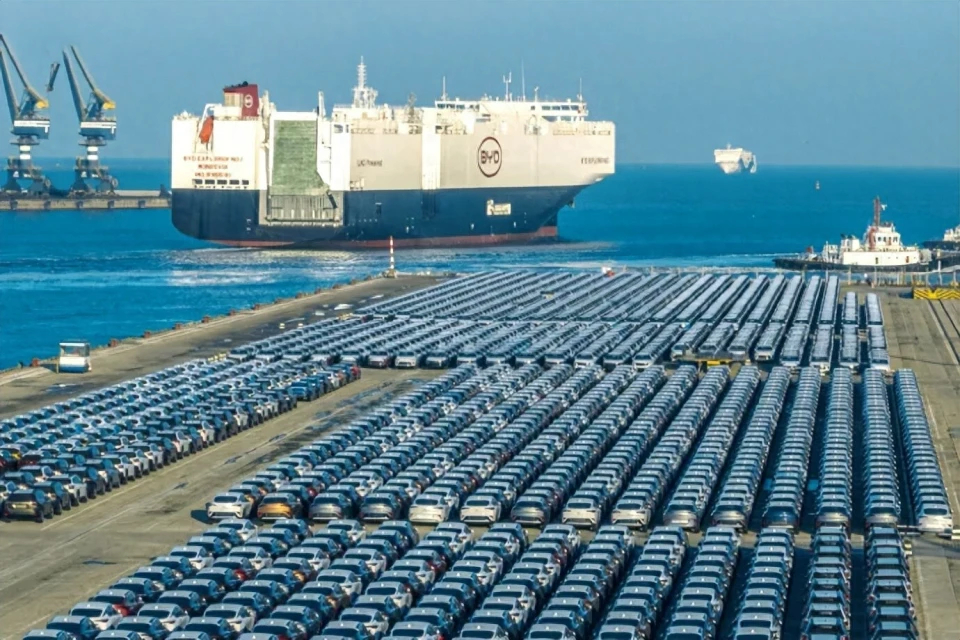
At present, the vast majority of Chinese automakers rely on the built-up (CBU) export model and have no local manufacturing footprint in Mexico, leaving them unable to avoid the new tariffs. To clear inventory before the new rules took effect, large volumes of vehicles were rushed to Mexico in late 2025, filling port storage to capacity.
This created an unusual market dynamic in 2026: local retail sales have not declined meaningfully, as dealers continue to work through last year's backlog, but new import declarations have shrunk dramatically.
As a result, China's vehicle exports to Mexico fell to just 210,200 units in the first half of 2026, down 25% year on year — a drop from first to sixth place in the rankings.
Mexico's boom-and-bust cycle serves as a wake-up call. Sales built on short-term policy dividends inherently lack resilience. Relying solely on the CBU export model leaves a market vulnerable to rapid reversal the moment trade policy shifts.
Diversification and Localization
In the span of a single year, the fortunes of two leading markets have flipped — a reflection of the realities of global automotive trade.
With global trade protectionism on the rise, countries are adjusting tariffs, market access rules, and product certification standards. No overseas market is permanently stable, and even strong products struggle to withstand sudden policy changes.
The good news is that, after years of expansion, China's auto exports have broken free from dependence on any single market.
Beyond Russia and Mexico, Brazil has become the largest overseas market for Chinese new energy vehicles, with exports approaching 300,000 units in the first half and stable growth momentum. Emerging markets such as Algeria, Italy, and the Philippines continue to expand, while Europe, Australia, and Southeast Asia are all growing in tandem.
With multiple markets sharing the load, overall export volumes can keep growing steadily even when top-tier markets like Russia and Mexico fluctuate.
Diversification hedges risk, but it does not fully solve the problem. Mexico's case demonstrates that the limitations of the CBU export model are becoming increasingly apparent. For Chinese automakers pursuing long-term overseas development, local manufacturing and regional assembly are no longer optional — they are the direction of travel.
Multiple Chinese automakers have already launched plans to build local plants in Mexico, aiming to circumvent tariff barriers and re-establish a foothold in the broader North American periphery. The Mexican market is not lost entirely — but the era of mass-volume, low-price CBU exports is over.
Overseas markets will always be full of variables. Policy dividends arrive quickly and fade just as fast, and the uncertainty of any single market can never be fully eliminated. Broadening global market coverage while continuously building localized operational capabilities remains the core competitive advantage for automakers looking to establish lasting roots abroad.